
Why Self-Care Isn't Fixing Your Burnout — and What Actually Works in 90 Seconds
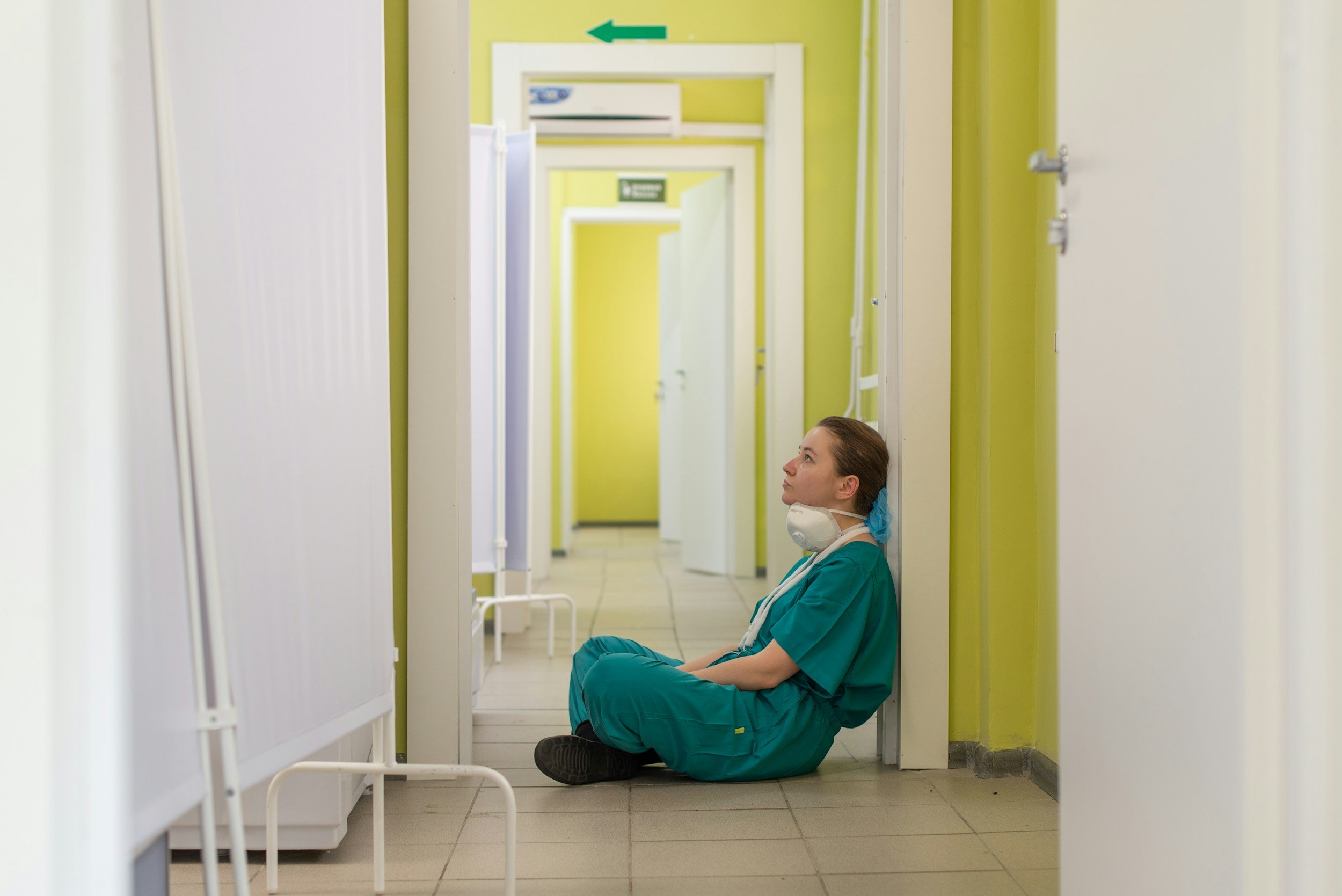
"I've tried the self-care stuff. Why do I still feel like this?"
Because burnout in high-acuity medicine isn't a self-care deficit: it's an unfinished stress response. Your body mobilized for threat and never got to complete the cycle, and no amount of bubble baths or meditation apps will close a loop that needs movement, connection, and meaning to close. The good news: the interventions that do work take 90 seconds, not 90 minutes, and they can happen between patients. Here's what they are and why they work.
Self-Care Was Built on the Wrong Model
Self-care isn't wrong. It's just aimed at the wrong target.
The concept was built on an individualistic model of stress or the idea that if something is wrong, both the problem and the solution live inside you. So the prescription becomes private, solitary, and inward. The implicit message is you need to restore yourself. If you're burned out, the logic goes, you must not have cared for yourself well enough.
That framing treats an almost inevitable response to an unnatural working environment as a personal failing. And practically speaking, it breaks down fast for medical providers:
It assumes you have leftover bandwidth. Time, energy, and attention after a shift — for many providers, there isn't any.
It collides with your identity. Self-sufficiency is part of how you survive this work; a prescription that says you're depleted, go fix yourself doesn't land.
It ignores that your work is relational. You are never alone in a resuscitation. The stress is shared. The loss is shared. The systemic obstacles are shared. Solitary solutions can't address collective exposure.
It assumes you need to calm down. Providers are doers, movers, and shakers. Many nervous systems need movement or external sensory input to regulate, not stillness.
The Stressor and the Stress Response Are Two Different Things
This is the distinction that changes everything: you can remove the stressor and the response still lives on.
Your sympathetic nervous system is your threat-response engine. When activated, it floods the body with catecholamines, raises heart rate, constricts vessels, heightens alertness, and suppresses digestion and immune function. In high-acuity work, most providers aren't in full fight-or-flight, but rather running on chronic low-grade sympathetic activation, a sustained threat posture that accumulates across shifts and years.
Somatically, that looks like:
Body tension and shallow breathing
Reactivity to sound and movement
Difficulty transitioning between patients or tasks
Trouble resting or settling
Deep, chronic exhaustion
Difficulty controlling anger or worry
Your parasympathetic system isn't just the "off switch." It's an active state of safety and connection. When you're in it, you read patient cues better, tolerate ambiguity better, make more nuanced decisions, and stay present under pressure. All skills that make you better at your job.
The problem is that the cues that invite parasympathetic engagement like felt safety, predictability, social connection, stillness are structurally rare in a hospital. Fluorescent lights, alarms, rapid task-switching, and human sounds of agony all signal threat. Your training asks you to scan for the problem. Almost nothing asks you to register the signs of safety and wellness that are also in the room.
Your nervous system is behaving normally in response to abnormal stimuli. What's been removed is the natural means of resolving it.
The 90-Second Reset: Micro-Dosing Safety
You don't need more coping strategies. You need slower, more intentional contact with what's already here. Two principles guide the on-shift work:
Titration over flooding. You don't need a ten-minute meditation. A single slow exhale, feet grounded to the floor, noticing one neutral object can shift the system back toward a regulated window without interrupting workflow.
Discharge, don't contain. Sympathetic energy that mobilizes but never completes needs somewhere to go. Shaking out your hands, stretching, or walking briskly between rooms serves that function.
A 90-second version you can run in a hallway:
Orient. Let your eyes move slowly around the space. Name two or three neutral or pleasant things — a shape, a color, the quality of the light. Let your head turn as you look. Quietly tell yourself: I'm here.
Notice, don't fix. Bring attention to your feet, your hands, your breath. Where's the tension? Where's the activation? No changes to make, just information gathering.
Let it move. Press your hands into a surface. Roll your shoulders. Press your feet into the floor. Shift your weight.
Extend the exhale. Try a "voo" or a low hum. Exhalation duration directly influences heart rate deceleration, and the vibration gives your interoceptive system something immediate and physical to process instead of the threat loop it was running.
Then check: did the tension soften, expand, or stay the same? That's data, not a test.
Regulating yourself is not indulgence. The body is the clinical instrument — provider dysregulation transmits to patients, families, and colleagues. Regulation is a clinical skill.
Shake, Share, Shape: Completing the Cycle After Your Shift
The stress response cycle is beautifully adaptive: activation, peak response, resolution. The problem isn't the cycle. The problem is the persistent low-level exposure plus the professional expectation to stay cool, calm, and collected means the cycle rarely closes.
If you remember one thing, remember these three:
Shake — intentional movement. The stress hormones that flooded your system during that code don't evaporate when the event ends. They need somewhere to go. Shake out, stretch, walk, move deliberately.
Share — positive social connection. Co-regulation, where one nervous system settles through proximity to another regulated one, is how humans have always recovered from threat. It's hardwired, it predates language, and it's precisely why solitary self-care falls short. Social connection is among the strongest known buffers against traumatic stress injury in high-exposure populations.
Shape — meaning-making. When something happens that doesn't have language yet — a baby that didn't make it, a family you couldn't reach, a moral injury you can't name — the unformed experience stays suspended in the nervous system, looking for a container. Narrative, image, and sound give it form.
Build a 5-Minute Transition Ritual
The drive home is the most underused regulation window most providers have. Pick one or two and make them yours:
Scent. Spritz something on your wrists that you use only for this moment. Scent is the fastest sensory pathway to the brain and becomes a powerful anchor over time.
Sound. A playlist reserved for the commute home, like a concert set list you loved, music from a wild and free stretch of your life, songs your grandpa played. Or hum: sustained vocalization is direct vagal stimulation, and a ten-minute hum genuinely moves the nervous system.
Temperature. Cold water on your face and wrists before you leave the building. Not to be clean, but as a deliberate I am leaving this behind.
Threshold. Before you open your front door, rest your hand on it and take three slow exhales. Or touch a stone or plant you've left there on purpose. Strange, and surprisingly effective.
Words. Some providers say a short closing phrase to themselves: I did what I could today. They are in good hands. I am going home now.
Witness. Voice-memo a colleague on the way home. Not to process everything, just to say that was a day. Being briefly witnessed closes a loop.
One nurse stops at the same gas station halfway home, buys the same candy, and eats it alone in the parking lot. Silly, sacred, hers. That's the standard: specific to you.
When It's More Than Stress
This part isn't about alarm — it's about recognition. Your work requires you to override your own body constantly. You silence hunger, push through exhaustion, and hold your breath through things that would break most people. That skill is part of what makes you extraordinary at this work. It's also why you may have no idea how you're actually doing until your body is at red alert.
If the exhaustion, numbness, irritability, sleep disruption, or intrusive images have stopped responding to rest, that's feedback worth acting on — not a character flaw.
Working With a Somatic Therapist in Bozeman
At Illuminate Counseling, some of us work with healthcare providers, first responders, and other high-exposure professionals across Bozeman and throughout Montana via telehealth. If you've been looking for a Bozeman therapist who understands provider trauma, or a somatic therapist who works with the nervous system rather than just the story, this is some of the work we do.
You don't need a personality transplant or a career change. You need your body to finish what it started.
By Sarah Webb, LCSW